Saturday, 25 October 2014

Voice Portfolio Entry 6: Articulation - Exercises To Help Correctly Apply It To Speech

Introduction:

In Phonetics and Phoneology, Articulation is the art of using the tongue, lips, jaw and other speech organs in order to produce sounds of speech.

Sound is simply produced by expelling air from the lungs.  However, to vary the sound quality in a way that can be useful for speaking, two speech organs normally need to come close together to contact each other, so as to create an obstruction that shapes the air in a particular fashion. 

The point of maximum obstruction is known as the place of articulation.  For example, when making a "P" sound, the upper and lower parts of the lips would come together in order to produce the sound of the letter.  The sound of the letter is produced by the blockage of air that the two parts of the lips are obstracting which is caused by the build-up of air pressure.

The Study And Practice Of Articulation:

During our session for 'Developing Voice For The Actor' this week, the group had continued to look at their own individual articulation.   Throughout this session, we took part in some practical exercises to see if we could further develop our own vocalisation skills.
    
Our teacher had began this session by having the group look at the layout of the The Oral Cavity (Mouth).  This was important as it would be able to help us all understand what we could all accomplish with our own articulation, and to also notify us which areas of our mouthes contains tension.  Through knowing these areas, I could enhance my vocalisation skills to result in me to present a new form of projection and correct articulation. 
    
The main areas of The Oral Cavity, which is to do with both pronunciation and vocalisation, consisted of:

For this session, our teacher had wanted us all to bring in a pocket mirror, to help us visualise each area of The Oral Cavity, and to perform a few exercises, with our mouths, which would possibly help develop our individual articulate skills.  We had also performed a few physical exercises from previous sessionso help us with focus and maintain a strong performing body.

The Process Of Exercises In Lesson And The Effects Taken From Them:

Before we had began our process for the Articulation exercises, our teacher had wanted us all to focus and consider on 3 main things:

1. To relax our bodies to the maximum.
2. Keep correct physical posture.
3. Correctly develop own individual breathe control.

Through these three points, we would all recieve the maximum effect to further developing our own individual Articulation skills.

Below, I'll be listing each exercise performed in a non-specific order, detailing what we had done within them and the effects that I'd gained from each:

Exercise 1. The Semi Supine:

For this exercise, we had performed 'The Alexander Technique', which required me to lie on my back to properly control and focus on your breathing, to result in a more relaxed state of mind, both physically and vocally.

Voice Portfolio Entry 3: Delving Into The Alexander Technique Link: http://sdcperformancens.blogspot.co.uk/2014/09/voice-portfolio-entry-4-posture-use-of.html

Above, I have included the link to a earlier entry in my Voice Portfolio's further detailing the process of the 'Alexander Technique', and the effects that I had contracted from performing it.


Evaluation For Exercise:
  • I had felt much more relaxed throughout my whole body than I had done prior Alexander Technique.
  • Both my body and voice had felt much more lighter than before, which had enabled me to develop the correctly positioned posture and make me speak more slowly, which had resulted in my words to become much more punctual and articluate.
Exercise 2. The Spinal Role:

Through doing this, I can maintain a more steady physical body posture and also keep a strong breathing pattern.  We had done a few physical stretches and flops to get all of our bodies in gear for the process. We had then performed a spinal role, where we had to bend our upper bodies down towards the ground, with knees bent. After doing this, we had then flopped around our arms, and then we slowly rose up to correct posture with our heads being the final thing to be correctly aligned/balanced. We had done this exercise 2 times within the process before we had moved onto the next exercise.

Evaluation For Exercise:
  • It had made me become much more energetic in what we were going to be achieveing in this process.
  • My body had felt a lot more relaxed post spinal role compared to before.
  • My body also felt a lot more warmer than before, maybe to do with the spinal role and letting all of the blood go through all of the areas in my body.
Exercise 3. Producing A Humming Sound:

By performing a humming sound through the use of, primarily, my throat, it would allow my vocal folds to warm up, resulting in any preparation for my vocalisation performance to enhance.

Evaluation For Exercise:
  • Having had a little bit of a blocked throat before performing this exercise, it had felt much more clearer after I had done it.
  • Since my main focus was on my vocal folds, I could feel them vibrating a lot more than if I had done this exercise beforehand without focusing on them.
Exercise 4. Stretching The Muscles:

This increased the overall movement within my body, since it released any unwanted tensions within it.  It had also given me much more energy and had also increased my overall focus towards both my physical posture and vocal folds, for better articulation both physically and vocally.

Evaluation For Exercise:
  • Before perfoming this exercise, I did have some unwanted tension in my shoulder blades, and after having performed this exercise, the tension did go away, resulting in me to gain the benefits from the exercise.
  • I felt much more active for the later activities since my body had felt free of movement with no obstacles, such as tension.
Exercise 5. The Tongue Exercise:

For this exercise, I had moved my tongue, around my whole mouth, in a certain pattern, as many times as I could to both release any unwanted tensions that is specifically placed within the Jaw area of the head, and also get a good exercise which tests the strength of my tongue, all of which would be needed towards the practicing and enhancment of my articulation.

Evaluation For Exercise:
  • Since I had unwanted tension in my Jaw area, I did have it released after having done this exercise.  I have allowed my Jaw to stretch in all directions due to the purpose of this exercise, and I had gained the proper benefits from doing so.
  • I did feel that sensation of a workout within my tongue whilst performing the exercise, it did get a little bit harder before I had finished the exercise, but I'd managed to pull through test and acknowledge the physical strength of my tongue.
Exercise 6. Releasing The Jaw:

By doing this, I had released any more unwanted tension that would of been in my Jaw, to enhance the feeling of movement, and to further increase the vocabulary in my speech.

Evaluation Of Exercise:
  • Much like with the 'Tongue Exercise', I had released the unwanted tension that was located within my Jaw area, and it did, indeed, enhance the feeling of movement, as previously mentioned.
  • After having done the exercise, I felt that it was a lot easier to project speech, probably due to the fact that the unwanted tension had been casted away, but also that my whole Oral Cavity had a massive stretch from doing it, which may have been the main cause overall for the purpose of this exercise.
Exercise 7. Projecting a Still Tone With A Closed Oral Cavity:

For this exercise, I had used a still tone, which was released from the back of my throat, and I had to produce the sound of a siren.  I had to perform the siren for as long as I could until I had run out of breath, to which we had repeated a second time, to see if I could produce the sound for a longer duration, and I can see this being a good exercise to redo for my vocal folds in the future.

Evaluation For Exercise:
  • Much like the 'Humming Sound' exercise, I did have increased focus on my vocal folds and I did, indeed, feel more vibrations within that part of my throat whilst performing this exercise.
  • For the second time that I'd performed this exercise, it did feel as though I had lasted longer in terms of air capacity, maybe due to the fact that I'd gotten my body used to the exercise and that for the second time, my lungs had allowed more air to be accessed when I'd inhaled a large breath before projecting the still tone.
Exercise 8. Nasal Cavity Sound Effect:

For this exercise, I had to perform and project a certain sound through my Nasal Cavity (Nose).  This had increased the air intake through my Nasal Cavity and I can see this being useful when it comes to the enhancment of my articulation.

Evaluation For Exercise:
  • I could definately feel the vibrations coursing through my nasal cavity during this exercise, and it had made my eyes feel a little bit weird also due to this.
  • Performing this exercise did release any unneeded blockage, and had allowed me to have proper inhalation through my nasal cavity after doing so.
Exercise 9. “Why fly so high?”:

With this exercise, I had to project my voice by performing with different tones and pitches of voice using both my Nasal and Oral Cavity.

The lines we had spoken were:

"Why fly so high? Said Naughty Nora, whilst eating an apple, with Zoe the Zebra in the Zoo"
(High/Light Voice)(Blocked Nasal)        (Open, Deep voice)       (Beating the upper chest)

Evaluation For Exercise:
  • For the "Why fly so high" part of the exercise, when trying to project a high/light voice, it did feel like my voice was 'braking' since I naturally have a very deep voice, but after having done the exercise again, I did manage to successfully pull of a high/light voice for the purpose of this part of the so called song. 
Exercise 10. Tongue Twisters:

For this exercise, we had perfomed a series of lines, which had a rhythm within it, with the pronunciation of each consonant within each word spoken.

The lines we had spoken were:

"What did you do to die today, what did you do to do. The dragon will come at the beat of the drum, a rat-tat-tat-tat-tat-tat-tat-tat-tat tum, what did you do do to die today, at quarter to two to two today at quarter to two to do."

To make this exercise a lot harder, and more old fashioned, we had to perform the exercise by changing the 't' sound in the words and replacing it with a 'd' sound instead. I say old fashioned because this is what actors do for a performance if the play takes place a long time before the present day.

Evaluation For Exercise:


Although I did have a hard time keeping up with the rest of the group with this sort of song, I did discover some benefits from performing it:
  • Having listened to my voice whilst announcing the words, I could hear the hidden consonants within the words being said, resulting in my speech to become much more punctual and articulate overall.
  • Having performed the breath control exercises prior to this did help with the flow of air I had needed in order to project each word with correct articulation.

Exercise 11. Working With Breath Control:


For the third exercise within this process, we had gone through 2 mini exercises which had required each of us to use our breath, whether it was to hold it for an amount of time or to release the air for as long as we could after inhaling a large amount of air.

To start off with, our teacher had made us perform the exercise which had consisted of us breathing in air for 4 beats, and then holding it for another 4 beats, until we had to release the air within another 4 beats. We continued this exercise multiple times with the amount of beats increasing for each. We had started with 4 beats, going to 6, and then finally finishing with 8 beats.

After performing that exercise, we had waited until or breathing pattern had gone back to normal again, until we were ready to perform the next one. This exercise was different than the previous because this time we had to exhale an amount of air for as long as we could.

Evaluation For Exercise:
  • Thanks to the first exercise I had performed prior to this, and also gaining the benefits from also performing the 'Alexander Technique', I was able to have a large amount of air capacity available for the purpose of this exercise.
  • After having done the exercise, I felt that my breathing pattern had changed, only slightly, to the point where I was actually breathing slower than before. This change of breathing pattern, strangely, didn't feel unnatural to me compared to what it was before, which would of been my normal breathing pattern.
  • I felt that I was speaking much more clearly when using my words since I can, having performed the exercise, now use the air to make my words be more articulate.
Analysis On How And Why Exercises In This Area Can Help Improve Vocal Performance:

From the information that I've gathered from my thorough evaluations of each of the exercises that I had done in my voice lesson, I have come to the conclusion that spending more time on these particular exercises could help to improve my overall air intake, ability to pronounce words properly and to enhance my overall stage presence for when I may have to start shouting on stage.

Obviously, more so, when being graded on the vocal quality of my performance for any project, doing exercises in this area will make my the letters in the words that I say come out more than if I had not done the exercises prior, making my speech much more clearer to understand.

Sunday, 19 October 2014

Level 3 Acting Week 6 Synopsis Blog

Monday 13th Of October 2014 Blog Entry:

Synopsis Of Day:

Lesson 1 - Physical Theatre:

To begin with this week, we carried on with the presentations for exploring the different contexts behind our play, '13'.  Since I haven't mentioned what all the presentations were about before this Blog Entry, I'll list each individual presentation and list each of the topics that the presenters had talked about in a separate blog and I'll also give my evaluation of these topics and how they have helped me in my knowledge of '13'.

Below, I have listed the link to this blog detailing my understanding of each one.

The Context Behind '13': http://sdcperformancens.blogspot.co.uk/2014/10/the-context-behind-13.html

After all of the presentations had been shown, our teacher had discussed how each group could develop their individual presentations to higher standard by giving some useful tips and tricks for presenting a piece of work.

After receiving our notes from this lesson, the 'Physical Theatre' lesson for this week had ended.  I had learnt a lot from this lesson about the context behind '13' and I thought about how I could possibly implement some of the topics discussed in these presentations towards my portrayal of Martin and Paul, especially with Martin being a Politician and Paul being a Christian Believer.

Lesson 2 - Contemporary Theatre:

After a short break, me and the group had returned to our rehearsal sessions.  For the time within this lesson, I had taken part in the development of both Act 2 Scene 7 and Act 2 Scene 11.  During this session, I had more time to develop the characterisation on one of my characters, Martin, and think about what his objectives and obstacles would be in these 2 scenes.  In my '13' Reflective Blog Entry for Week 4, I'll talk more about my contributions to this session and I'll also give my own judgement towards these 2 scenes as to how me and the other actors had performed it.

I had also thought more about both of my characters costumes and their uses of props within their scenes.  I'll include detail about this more in my Reflective Blog for this week but even more so in the completion of my character profile for '13'.

After a long day of rehearsing already blocked scenes and reading into the scenes that I'm in later on in the play, the 'Contemporary Theatre' lesson and day had ended.  I have a bunch of topics that I can talk about in my Reflective Blog for this week and I have thought more about what I could potentially include in my upcoming character profile which gives much more specific detail about my interpretation of both Martin and Paul.

Wednesday 15th Of October 2014 Blog Entry:

Synopsis Of Day:

Lesson 1 & 2 - Principals Of Acting And The Historical Context Of Performance:

For the duration of these 2 lessons, our teacher, along with the group, had worked towards finalizing the blocking for the whole of Act 2, so that for next weeks lessons, we can all move onto Act 3 & 4.

During this rehearsal session, I had worked more on my characterisation for Martin in his scenes for Act 2 and 3, and I also thought more about what I can talk about in my Reflective Blog for '13' this week through doing this.

Not much more was discovered in this rehearsal session by reading the script, but at least I've had a good time going over my scenes as Martin and Paul once more so I can feel more comfortable with the scenes I'm performing in.

Lesson 3 - Performing Arts Business:

During the lesson for this week, I had worked more on both my presentation, which details my 'Five Year Plan' and my Personal Statement.  I had also made a start towards the creation of my Actors CV and I had also completed an Application Form for a Drama School.

I had received some homework from this lesson, which was to send the first draft of both my Personal Statement and my Actors CV to my teacher by the end of next week, before half term, for it to be marked and be given areas of improvement.

Lesson 4 - Developing Voice For The Actor:

For my 'Developing Voice For The Actor' lesson for this week, our teacher had the group look towards Articulation and made us perform a series of exercises to help work towards it.  My homework from this lesson is to complete the 4th Chapter for my Actors Portfolio which is the topic of Articulation.

Thursday 16th Of October 2014 Blog Entry:

Synopsis Of Day:

Lesson 1 - Tutorial:

For this weeks Tutorial lesson, I had received personal feedback about my Reflective Blog Entries from my teacher.  She had given me specific areas of improvement for these Blogs such as how I should write and structure it, so that she gains the most important information about what I had learnt from the rehearsal sessions for '13', and to also include more bullet points, with short paragraphs, detailing my judgements/contributions and use of stagecraft towards any scenes, either mine or others, in the play.

My teacher had heavily complimented my work on these Blogs by saying that I have a very clear articulate way of writing, but she only wants to know what I had done in each rehearsal session and how I had arrived to this point and also giving my judgments towards it.  I had left this session feeling more comfortable with as to how I should be writing my Blogs and, hopefully, I'll be posting them to my teachers standards.

Lesson 2 - Performance Workshop:

In this lesson, our teacher had worked on blocking the final scenes in Act 2 so that we can move onto Act 3 and 4 next week before I go away on my half term.  For the duration of this session, I had worked more on all of the scenes that I had blocked so far from Act 1 and also Act 2 as Martin and Paul.

As Martin, I don't appear in the later scenes of Act 2, so I was taking part as an audience member for these scenes so I can witness the development of them and also give any ideas towards it to help my teacher in the blocking process.

After finishing and blocking all of the scenes in Act 2, my 'Performance Workshop' lesson and day had ended.  I'll be working on several blogs over the weekend to show all of my physical understanding of '13', and I'll also be making improvements towards my upcoming character profile. I'll also have the time to go out and choose my costumes for both Martin and Paul and pick up any possible props that I can bring into their scenes.

'13' By Mike Bartlett - Reflective Blog - Entry 4

'13' By Mike Bartlett - Reflective Blog - Entry 4

Introduction - The Context Behind '13':

Week 6 Synopsis Blog: http://sdcperformancens.blogspot.co.uk/2014/10/level-3-acting-extended-diploma-week-6.html

Above, I have included my Week 6 Synopsis Blog, to give background detail as to what I had done in my weekly sessions. 

For the beginning of Week 6, I had finally witnessed each individual group of partners presentations about a specific context of performance behind '13'.  Each one of these presentations had revealed all of the hidden details behind our play, and has increased my overall understanding of it, much to the point where I can reflect some of the things the presenters were talking about into my overall physical characterisation for both Martin and Paul.

The Context Behind '13': http://sdcperformancens.blogspot.co.uk/2014/10/the-context-behind-13.html

Above, I have included a link to a separate blog showing my understanding for each of these presentations and how I could possibly implement each groups ideas into my performance of Martin and Paul.

Performance Workshop:

In the rehearsal sessions for Week 6, the group, along with blocking sessions from our teacher, had completed the whole of Act 2 and we're now able to move onto Act 3 & 4 next week.

Act 2 Scene 7

Rehearsal Methods:

To start off the blocking of this scene, we had staged it with the stagecraft technique of 'The Plate', to balance out the scene and allow for some unique ways of movement for each character in this scene.

This scene takes place in what would be a meeting room and by implementing 'The Plate' technique, it did, I feel, give a better portrayal and it did bring more meaning towards the individual characters ways of movement within it.

Character Objectives And Obstacles/Input:

For my portrayal as Martin in the blocking session of Act 2 Scene 7, I had an objective but I didn't have an obstacle.  After having thought more about what my obstacle could be in this scene, I had come to the conclusion that there really isn't one since I'm sitting down for the majority of it and nothing is there to necessarily 'block' my path.

There was, however, something that was implemented at the beginning of this scene to do with Martin that I do consider a minor obstacle, which is that I arrive late to this meeting and Ruth, the British Prime Minister and Dennis, the U.S Ambassador, are looking at me with a negative expression on their face, which results in Martin to not sit down on his chair for a second since he's feeling down, and that he has given himself a bad impression towards both Dennis and Ruth.  Martin does make up for this however by remembering to bring along the background information files that he hands out during this scene, which is my objective, before his first line when Sir Christopher is being introduced to Dennis.

By having this objective, I felt that Martin did have more of a purpose within this scene and I consider him a key character because of this.

Strengths And Weaknesses In Scene:

For my portrayal of Martin in this scene, I feel that I'm making a good effort to express my opinions towards what the other characters are saying with facial expressions and change of body language.  But I feel that I could potentially work on my facial expressions and body language more since I think I'm doing too little in this scene. 

An aim for the next time I do this scene would be to try and accomplish more of these two things to able to boost the potential of my overall performance within it since, because I only have one line in this scene, I feel that there could be a lot to experiment with.

Other than the Strengths I had noticed in my performance for this scene, I didn't really discover any Weaknesses either.  To me, this is a good thing to realise, but I should explore the scene more, either in my own time or with the other actors, to try and discover any potential weaknesses in my performance.

Evaluation Of Act 2 Scene 7:

* I feel that by the way that this scene has been blocked and how some of the actors present their lines, it sets a powerful moment and really reveals to the audience the true purpose behind this play.  It makes the audience think more about who really is the villain/hero in this story and will leave them to wonder until the end of the play, where all will be revealed. 

* The staging used in this scene, I feel, gathers the whole audience, as though they were also at this meeting and are performing as side characters.  The speeches that Sir Christopher, the Head of the Armed Forces, presents, I feel, creates a thrilling atmosphere that really binds the audiences eyes as to what is really going on behind the story of '13'.

* The talk of nuclear weaponry and the scene ending with Ruth left in deep thought about her future plans really creates a very deep tense moment for both the actor and the audience for the rest of the play.

Act 2 Scene 11

Rehearsal Methods:

To start off the blocking of this scene, we had, again, implemented the stagecraft technique of 'The Plate' to balance out the scene, by having a certain number of actors stand/sit in a certain area, to allow for some unique ways of movement.

Since this scene is meant to take place in a park scenario, implementing this use of stagecraft did make the overall presentation of the scene feel like it had more meaning and that it had brought a real purpose for the audience to discover, and since the scene is meant to represent a large area, I did feel like that the audience was also part of the scene by being spectators of Johns speech.

By using the stagecraft technique of 'The Plate', I had realised that it had brought the circular fashion of staging that Mike Bartlett had intended for the presentation of '13'.  This type of staging was unique and nothing I had realised before in any performance that I have seen, so using it for this play is something that is exciting to me.

Character Objectives And Obstacles/Input:

For my portrayal as Martin in Act 2 Scene 11, I did have an objective and obstacle in mind that I had wanted to input into the blocking of this scene.  Since it's a scene with a speech being presented by John, my objective was to listen to it and to either agree or disagree with his ideas.  I actually agreed with everything that John had presented in this scene because of a line I had discovered, through reading the script, in Act 4 Scene 6, where I present my opinion towards Johns' speeches to Ruth by saying "I think he's good."

I didn't have an obstacle in this scene when it was being blocked, but after having thought more about the scene, there is a character in this scene, Holly, that is gathering E-Mails throughout the duration of the speech and after it.

I'm making a suggestion that instead of Holly asking for Martins E-Mail address at the beginning of the scene, before John presents his speech, she will become an obstacle to Martin when he is about to leave the scene, which takes place right after the speech, due to him looking down and realising the time on his watch, since he was on his lunch break, and she will stop him in his tracks, hence becoming the obstacle.  I will discuss this idea with my teacher to hopefully implement it into the scene so Martin has more of a purpose within it.

Strengths And Weaknesses:

Since I don't have any lines for Martin in this scene, I feel confident that my physical performance, using gestures and facial expressions to show my opinion towards Johns speech, is to a good standard.

I do think that I should move more in this scene perhaps, since I'm sitting on a park bench for all of it until I quickly depart the scene after the speech.  I'll experiment with the use of movement if I can rehearse the scene once more with the other actors in the scene to try and implement it in to hopefully boost my overall performance in this scene.

Evaluation Of Act 2 Scene 11:

* This scene in particular creates an understanding about some of the characters within '13', such as Stephen when John is introducing Holly to him.  It also reveals some unnerving, emotional moments for some of the characters, especially Mark and Holly, when they are talking to each other at the end of the scene about them not being in contact with each other since Holly is scared of Mark and cries when John asks her if she is alright after he had left the conversation.

* This scene, much like Act 2 Scene 7, makes the audience wonder, again, who is the villain/hero in this mysterious, thrilling story, because of the speech that John presents, which mainly discusses the benefits of siding with him in this political crisis.  How John interacts with the other characters in a calm and peaceful matter really makes the audience question what his true intentions are.

Aims For Next Rehearsal Lesson:

After having gone through and blocked a few scenes with my characters, I now feel that I should start implementing the use of costumes and props to help bring a visual representation and bring my characters, Martin and Paul, to life.

I've considered the use of props with Martin since for some scenes, for example Act 1 Scene 4 and Act 4 Scene 6, he uses a personal diary, to keep track of daily events, and an I-Pad, to keep up to date with the latest news broadcasts.

I do have possession of these two props, as well as the costumes, for my characters, so for next session, I'll bring in all of these props to help create and express my interpretation of both of my characters.

Conclusion:
  
I think that for this weeks rehearsal sessions, for the completion of Act 2, was an amazing experience to delve into.  I had much more time to work with my character and his main objectives and obstacles within scenes and it also gave me much more time to work on the movement of the play due to the type of stagecraft that we are going to be implementing into our performance of '13' in November.


'13' By Mike Bartlett - Contextual Research

The Context Behind '13'

Presentation 1 - The War During '13':

The first presentation had shown the process of exploration that the pair had done to give their interpretation of a possible war taking place during the time of '13'.  The war that this group was working with was the one which took place in Iran during 2010-2011, the year that '13' is set.

One of the notes that I had gained from this presentation is that in June 2010, the U.N Security Council had imposed a round of accusations against the Iranians which included tighter financial funds and weapon restrictions.  There was also talk of a possible production of nuclear weaponry being made in Iran.

I had linked this information towards Act 2 Scene 7 of '13', which includes the British Prime Minister, and her three Political Advisers, having a meeting with the U.S Ambassador and the Head of the Armed Forces.  The speech that the Head of the Armed Forces (Sir Christopher) presents in this scene about Nuclear Weapons may relate to what the researchers had found out for this presentation.

Through reading the text in this scene, I feel confident that the topics presented in both the presentation and the play, about the Iranian war, are closely related, much to the point that they may represent the same thing.  Through knowing this, my interpretation of this scene had changed exponentially, I have a much better understanding of what the characters in this scene are talking about and how I can reflect this in my performance.

Presentation 2 - Moral In Politics Within '13':

For this presentation, the pair had posed a question towards the entire audience: Is War the best option?  Much like the previous presentation, this one had discussed more of the political side of the Iranian War and had included some points that show the relation between Ruth and David Cameron, since they are both the British Prime Minister during 2011.

One of the notes that I had taken down, which I thought was interesting, was that David Cameron, had presented this quote in a live speech:

"Under my leadership, the Conservative Party has modernised."

This specific quote has a strong relation to the same quote in '13' that Ruth presents during her speech in Act 1 Scene 13.  This had interested me because it shows another physical influence behind Mike Bartlett's creation of the character Ruth for '13'.

I think it's smart how Mike Bartlett had implemented an almost identical copy of David Cameron into '13', to possibly give his opinions towards her decisions with the other characters in the play.

This can relate to one my characters, Martin, who, at some points, may disagree with what Ruth had announced in this speech through my interpretation of him since he is meant to be showing that he is scared of what's going to happen later on in this war, and Ruth states that everyone shouldn't be afraid.

Presentation 3 - Relationship Towards The Biblical Text:

In this presentation, the pair of researchers had delved into the script of '13' and had explored the possibility of the story of  '13' being linked towards Jesus and the 12 Disciples, which was the question that they had opened with.

The researchers for this presentations had compared a certain number of characters in '13' to some that are in the biblical text, to show their similarities and justify their point.  Below I will list 2 examples:

* John = Jesus:
The researchers had suggested that Jesus, in the biblical text, is strongly related to John in '13' because they both, mysteriously, had come back from the dead due to an event, which in '13' isn't detailed, with a specific purpose that benefits the general public.  For Jesus, it was to spread the word of his return for guidance and to also scare off the Roman Empire; for John, it was to help give the general public a brighter future by protesting against the British Government and their Political opinions.

* Peter = Amir:
The researchers had suggested that Peter, in the biblical story, is strongly related to Amir in '13' because they are both spokesmen for their leader in both stories.  Peter was Jesus' right hand man, and had spread his good word to all of the people in the region; Amir is also, later on in '13', the right hand man for John and had supported alongside him in his public speeches to rally against the British Government.

I strongly agree that '13' has a very strong relationship towards the biblical story of Jesus and the 12 Disciples since the purpose behind both stories is similar, and the characters have a strong familiarity with each other.

When performing as my second character, Paul, I will research into Christian Beliefs, since he is Christian and I think that doing this may benefit my overall performance in the Alpha Session for Act 1 Scene 12.

Presentation 4 - Economic Link Between Reality And '13':

For this presentation, the researchers had delved into the study of economics, and had given their interpretation of the link between reality and '13' with this in mind.

As already stated in another presentation, David Cameron is strongly related to the character of Ruth in '13', since they are both leaders of the Conservative party and the British Prime Ministers during the time of 2010-2011.

During his time as Prime Minister, David Cameron had raised unemployment in the U.K from 7000 to nearly 2.5 Million.  This could also be the case for Ruth, as the protesters that appear throughout '13' may be these unemployed people causing riots, with the help of John, against her political decisions.  Also during this time, the recession was at its peak and it has now been known to be the worst global recession since the second world war.

Presentation 5 - All Aspects Of '13':

For the first presentation, the topic of interest was all the different aspects of '13', and the researchers for this topic had plenty of interesting things to talk about.

They had researched about the author of '13', Mike Bartlett, telling the group of his past life and education and previous stories that he had written.  Mike Bartlett was a student in Creative Writing and English Literature, which had resulted in him to become a brilliant story teller.

The researchers in this group then went to talk about the different people in '13' and the specified religions that they all follow.

They talk about the Alpha Scene in '13', which contains a group of Christian believers, and talked about the conflict between this religion and the Politicians in the play.  They then talked about how Atheism is in the play as well since the character called Stephen is an Atheist.

They then finally talked about all the riots that had occurred in 2011, which is when '13' is set.  The riot that they specifically talked about is one called the 'Blackberry Riot', which is a riot that was heavily connected with social media devices such as Mobiles and Tablets and was spread on social networking websites such as Facebook, Twitter etc.

I'll be using both my Mobile Phone and I-Pad during my performance as Martin in '13' to coincide with the social media aspect within it.

Presentation 6 - The Religons and Political Issues In '13':

For this presentation, the topic was to talk about all the religions within '13' and to also talk about the Political problems that would of occurred at the time of the play.

They had researched that during 2011, there were a bunch of riots, especially in London, which was caused by problems such as Economic Crisis's, and disagreement with Political matters, even the Royal Family had risen a bunch of tension which caused a great concern for the people of England.

I also took note that David Cameron was elected as the British Prime Minister at this time so, as something I don't really follow to often, this has to have been a very grim time in terms of Political matters.

The Political and Religious points that were presented in the researchers slideshow is, they claimed, to have been intertwined within '13', and the lines that each character presents with relation to these two topics is over-exaggerated throughout the whole duration of the play.

Presentation 7 - The General Themes Of '13':

For this presentation, the general topic of interest was about the war which took place in Iran in 2011, and also how the British and American Government were in an economic crisis and had Political disagreements which had resulted in each of the individual countries leaders to become hated by their people and this caused riots to occur.

Within '13', the British Prime Minister, Ruth, had supported in the invasion against Iran, which did bring all of the riots that occurs within some of the scenes throughout the whole play.  These riots were happening because people were dying and families were becoming very angry with their Political leader, being Ruth.

Since Ruth is a leader of the Conservative Party, an interesting point was brought up being that the Conservative Party's real name, from it's creation in 1912, is the Conservative and Unionist Party, but due to this name never being used by the general public, this is not known by many people.

There were also topics that were being brought up within the presentation which were about the development of nuclear weapons, the Government and the individual Political powers, British Youth and Economic Problems.

They had concluded their presentation by saying that the themes of '13' are mainly based on real events used with fictional facts to further exaggerate the problems occurring within 2011, the time in which '13' takes place.

Presentation 10 - A Review From Dan Hutton:

For this presentation, the lone researcher had delved into the themes within a review of '13' given by a critic named Dan Hutton.

She had expressed his opinions on the conflict between some of the characters in '13', especially Ruth and John, and had explored and presented the points of:

* Prime Minister VS The Modern Messiah
* Female VS Male Characters
* The Rise To Power - How Did They Get To Power?
* Why Do People Disagree?

Presentation 11 - The Relevance To Contemporary Society Within '13':

This was the presentation that me and my partner had researched for, and our main topic of discussion was to show the plays relevance to contemporary society.

We had both researched from reviews given by critics towards the performance of '13' from the National Theatre in London, and had also looked at their website to find any more information that relates to the topic at hand.

The two different areas that me and my partner had covered for this presentation was the impact of social media and each of the individual characters links towards modern society.  By researching this, we had come to the conclusion that the characters within '13' give a realistic representation of the people within our modern society.  This presented us the question as to how all of this could possibly impact each actors representation of their own character and how we could tell the story of '13' overall to an audience.

Within our presentation, we had shown to the group that the fiction of Mike Bartlett's play collides with modern reality and this may have been an intention for Mike Bartlett's creation of '13'.

These were mine and my partners research areas for this presentation:
* ‘13’ Review by Aleks Sierz - http://www.thestage.co.uk/reviews/review.php/33998/1
* The National Theatre Website - http://www.nationaltheatre.org.uk/shows/13

Conclusion:

To conclude the presentations, we presented any concerns/questions about the topics to each group of presenters and our teacher had given them feedback about how they could improve the presentation for next time. These improvements were things like including short, detailed bullet points and having Que cards so they aren't reading off of a script and it would actually look like they had learnt something from doing the research for the presentation. Pretty much all of the groups have had this happen, but I still think they all made a good effort and produced a decent piece of work to present to an audience.

All of these power points that have been presented have helped me in my research process for '13' and I feel that I have an even more increased knowledge in the various context's behind Mike Bartlett's play.  When it comes to completing my Character Profile for '13', I'll use the information I had gained from this lesson, in note form, to give further detail into both of my characters in '13', Martin and Paul, and I can talk about all of the different topics and present my own interpretation for their own opinion towards them.

Tuesday, 14 October 2014

Voice Portfolio Entry 5: Vocal Cords - How To Correctly Apply It To Performance

Introduction To Vocal Cords:

Speech is an ability to express our feelings, thoughts and has evolved with humans in the last few thousand years.  Although all animals possess vocal cords and produce typical noises and sound, speeches and musicals are only connected with humans.  Evolution of speech, and in turn, that of the Larynx, the voice box of our bodies, resulted in the developmental activities like speaking and singing.  But the Larynx, singularly, does not control all of the functioning of the sound, rather it works together with the rib cage, back muscles, lungs, oral cavity and the vocal cords in order to create the magic of the sound of speech.

For this third chapter in my Actors Portfolio, I'll be talking about the vocal cords and their primary functions to come to a conclusion of how humans produce sounds, such as voice, from their mouths.

A Description Of The Vocal Cords:

The vocal cords are the two folds of skin within the throat that are related to the mucous membrane which moves further into the larynx's interior cavity and is, basically, the producer of sound.  The sound is generally created when the folds 'vibrate' as a response to the air movement inside these folds when the lungs exhale air.  The pitch of the human voice is determined by the vibration frequencies.  When compared to men and women and children, the vocal cords are shorter, as well as thinner, due to the result of a higher pitched voice, this changes to a deeper voice as the child gets older.

What Is The Connection Between Our Speech And The Vocal Cords:

Both the vocal tract and the vocal cords have a major role to play in the production of our speech.  Several organs are present inside the vocal tract and they regularly monitor and control the centers of speech.  The sound of speech is created when the lungs exhale air which then results in a vibration within the vocal cords, turbulence is also created inside the vocal tract at the same juncture.  The sound harmonics are significantly influenced by the vocal tract's shape.  The vibration of the vocal cords as well as the varying shape of the vocal tract creates the typical individual speech sounds which each person is accustomed to.

An Explaination Of How The Vocal Cords Work:

The vocal cords, or medically termed as the vocal folds, are the mucous membrane that opens and closes in a snap during the process of speaking, singing or while we make noises.  When the air pressure is increased against the folds of the vocal cords, they snap and produce a sound.  When the snapping is gentle, the action produces a very soft and gentle sound, and when the snapping is more forceful, we hear a loud sound or noise.  The pitch of the sound goes on with the increase in frequency of the folds opening and closing.  In normal human speeches, the vocal cords have been known to perform the action of opening and closing 100 times a second.

What Are The Resonators:

Surprisingly, the vocal quality is not influenced by the vocal cords or vocal tract.  Rather other anatomical structures like palate, tongue, nasal cavity, oral cavity, chest cavity, pharynx and the sinus cavity all influence it.  Vocal cords, on their own, only create a buzzing like sound, but the resonators contribute along with the vocal cords in making the sounds essential for music and speech.

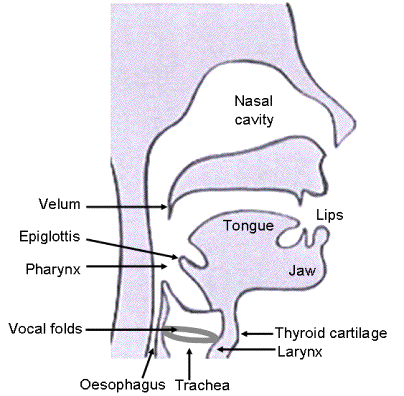
Within our 'Developing Voice For The Actor' Lesson, we had experimented with seven areas that may be listed as possible vocal resonators. In sequence from the lowest within the body to the highest, these areas are the chest, the tracheal tree, the larynx itself, the pharynx, the oral cavity, the nasal cavity, and the sinuses.

1. The Chest:

The Chest is not an effective resonator. Although strong vibratory sensations may be experienced in the upper chest, and although numerous voice books refer to chest resonance, the chest, by virtue of its design and location, can make no significant contribution to the resonance system of the voice.

The Chest is on the wrong side of the vocal folds and there is nothing in the design of the lungs that could serve to reflect sound waves back toward the larynx.

2. The Tracheal Tree:

The Tracheal Tree makes significant contribution to the resonance system except for a negative effect around its resonant frequency. The Trachea and the Bronchial Tubes combine to form an inverted Y-shaped structure known as the Tracheal Tree. It lies just below the Larynx, and, unlike the interior of the lungs, has a definite tubular shape and comparatively hard surfaces.

The response of the Tracheal Tree is the same for all pitches except for its own resonant frequency. When this resonant frequency is reached, the response of the subglottic tube is to act as an acoustical impedance, or interference, which tends to upset the phonatory function of the Larynx.

Research has placed the resonant frequency of the subglottal system or Tracheal Tree around the E-flat above "middle C" for both men and women, varying somewhat with the size of the individual.

3. The Larynx:

Due to its small size, the Larynx acts as a resonator only for high frequencies. Research indicates that one of the desirable attributes of good vocal tone is a prominent overtone lying between 2800 and 3200 hertz, with male voices nearer the lower limit and female voices nearer the upper.

There are several areas in or adjacent to the Larynx which might resonate such a high pitch. Among them are the collar of the Larynx, the ventricles of Morgani, the Vallecula, and the Pyriform Sinuses.

4. The Pharynx:

The pharynx is the most important resonator by virtue of its position, size, and degree of adjustability. It is the first cavity of any size through which the product of the laryngeal vibrator passes; the other supraglottal cavities have to accept whatever the pharynx passes on to them.

5. The Oral Cavity:

The Oral Cavity is the second most effective resonator within our bodies.

6. The Nasal Cavity:

The Nasal Cavity is the third most effective resonator within our bodies.

7. The Sinuses:

The sinuses are extremely important to our voice modulation within our bodies.

Below, I'll include an image of the vocal cords:


Exercise Done In Lesson:

When I had received my next entry task for the portfolio, which was about Vocal Folds, we had moved onto an exercise which required the group to find their own Larynx in their throat and move it around very gently, which does help some actors with their Vocal Cords. This exercise wasn't very entertaining for me since it made me feel a little bit under the weather after performing it but if I have to do it more in the future (which hopefully I don't need to since it's not necessarily required) I won't receive the same effects that I had from doing it in today's lesson.

Before we had performed this exercise, our teacher had wanted all of us to partake in a warm-up session, involving the Larynx, which required us to move, very slowly in a circular manner, our own individual Larynx's. We had done this for about 30 seconds before we had moved onto the exercise. Since, as I have already mentioned, I felt a little under the weather whilst performing this exercise, I did feel a slight sensation in the Larynx area of my throat before this took effect, which may possibly be what the exercise had intended to bring.

Having performed the same warm-up and exercise again at home on a different day, I still did feel under the weather from doing it but, again, I did feel some sort of soothing sensation in my throat before this had taken effect once more. Hopefully when performing this exercise more in the future, I'll be able to go through it for a much longer duration to result in a better outcome for my voicework.

It wasn't neccisarily in this session where we had accessed our resonators, but instead in the session where we performed exercises for developing our Articulation.  Through the exercises we had done in this session, we had used some of the resonators, listed above (The Chest, The Tracheal Tree, The Larynx and the Sinuses), to help assist us with the different exercises to properly project the production of our voice.

Analysis Of How And Why Exercises In this Area Can Help Improve Vocal Performance:

It's a common misconception that taking voice lessons will automatically improve your vocal ability. One time, you may hear Simon Cowell on Britain's Got Talent/American Idol, or even your teacher at school, recommend vocal lessons. There is definitely validity in this, however, you have to put forth the effort to make this worthwhile, even singing along to your favourite song won't do it.

I ask myself one question during this analysis: "How can I improve my voice?"

The answer to this question is: Exercise, regularly!

If someone wants to become a stronger vocalist in performance, by having increased vocal range and able to control it with ease, they have to exercise their voice daily. The Vocal Cords are a muscle in the Human Body. Like every other muscle in the Human Body, you will not gain any strength and/or stamina by not working them out regularly.

The Vocal Cords are a unique instrument to use, especially as an actor in a performance. If someone doesn't exercise their Vocal Cords regularly, they will have trouble projecting their voice more than if they had done exercises for it, which inevitably improves that actors performance in vocal terms.

You should work out your voice at least 20 minutes daily (at minimum). As time goes by, and the voice seems to be improving, extend the exercise to 40 minutes or an hour daily.

Level 3 Acting Week 5: Business Homework - Creation Of My Personal Statement

Introduction:

For this Blog entry, I will be covering the main areas of interest for when I would join a Drama School/University.  The three main areas of interest are:

1. Why do you want to do this course?
2. What makes you right for this course?
3. What else have you done that would contribute towards your university life?

I have to think about the answers to these questions as it will help me when I have come to the point of writing my own Personal Statement in the future of my Acting career.

Choice Of University And Course Description:

For the purpose of this Personal Statement, I will be looking into the Drama School called Mountview Academy of Theatre Arts, which is located in London.  The course I will be covering is called BA (HONS) in Performance - Acting Diploma in Professional Acting.  The course at this institute lasts for a total of 3 years and covers various skills within the Performing Arts Industry which is relevant to an Actor, such as myself:

By reading through what the website for Mountview has said about this course, I know that it is an engaging and thorough process in the training of the arts that prepares students for contemporary theatre and its associated industries. The study for this course is carried out through direct engagement in practical work. Students that apply for this course will be working on a number of performance projects across the three year duration that includes contemporary writing and having the opportunity to devise and experiment with original work for Shakespearean, European and American Drama's. This all interests me because I love to re-enact Shakespeare's plays and also to perform in modern drama. I love the idea that I get to experiment with the many styles of performance, which this course provides, to result in the improvement of my skills in performance.

Students take part in a variety of modules which includes Acting, Screen Acting, Actor & Text, Animal Movement, Clown Work, Dance, Improvisation, Movement, Radio Technique, Sight Reading, Singing, Stage Combat, Verse Speaking and Voice. Students will receive feedback on their work throughout the course, with performance strengths and weaknesses examined and advice offered on further areas of future development. The things that interest me the most about this course has definitely got to be the amount of performance projects that this course provides for its students. I love being on stage and performing as a character, but I love even more the journey to becoming that character, going through the development process to fully embody them, physically and mentally, to pull off the most effective and realistic performance.

This course can lead me on a good path within the Performing Arts Industry, I'll come out of this course after the three years with an agent which will find work for me immediately in either theatre or film productions. This is what my dream is to achieve in my life, I love the idea of performing on a theatre or film set and having fun doing it and I'll also actually get paid to do it as a job. The only interest I have that relates specifically to this course is that I love performing in front of an audience. In the past, I have been with theatre companies in my area and this had interested me until I had to unfortunately leave the company due to studying at college and putting my full time into my own work in order to achieve the best grade that I could get on the course.

At South Downs College, I had completed the Btec Level 2 Performing Arts course and achieved a Distinction Star grade. I'm currently on the Level 3 Acting Extended Diploma and I'm working as hard as I was to be able to hopefully achieve the same grade.

As boring and unsocial as it sounds, I love to produce hard, detailed work, which has resulted in me to get to where I am today in my acting career. I love to keep physically fit going to my local gymnasium. In the past, I have had experience with Customer Service. I've learnt that performing in plays, in my opinion, goes towards the idea of Customer Service, especially for this course, in an unusual concept. People pay to watch the many productions that are being provided by a local theatre, and it's the actor’s job to provide the customers with the service of performing an entertaining and outstanding performance.

For my career in becoming an Actor, there is one thing that I think about constantly that motivates me and keeps me working at my best: "It's not about the destination, it's about the journey". The journey is a road that goes infinitely which expands and leads to the individual contexts of a performance. Through knowing this, I know what kind of actor I want to be in life and I shall keep on this road to reach it knowing full well that the journey never ends, because there is always more to learn.


'13' By Mike Bartlett - Reflective Blog - Entry 3

'13' By Mike Bartlett - Reflective Blog - Entry 3

Links/Detailed Information As To What I Had Learnt In Lessons - My Weekly Blog Entry 5:

Week 5: http://sdcperformancens.blogspot.co.uk/2014/10/level-3-acting-extended-diploma-week-5.html

Introduction: Refining Act 1 Of '13':

Above is a link to my Weekly Blog Entry for the 5th Week on the Level 3 Acting Extended Diploma Course.  Throughout the first section titled 'Monday 6th Of October 2014' captioned 'Lesson 1 & 2 - Physical Theatre And Contemporary Theatre', I talked about what I had done in these lessons to further refine Act 1 of '13'', so we can move onto blocking and refining Act 2 for next weeks lesson.

In this Blog Entry, I talked about how I had made a brief character profile for my characters in '13', Martin and Paul, and I've also considered the idea to also make a profile for my interpretation for every other character in '13'.

When I have completed a sufficient amount of work on my '13 By Mike Bartlett - Character Profile' Blog Entry, I will include the link for it in the 'Links/Detailed Information As To What I had Learnt In Lessons' section for this Reflective Blog. For this Character Profile, I will have presented my overall interpretation of my characters, Martin and Paul, also including any other characters in '13', and presenting the several strategies that I will be implementing into both Martin and Paul to give a different overall presentation for both characters for future rehearsal sessions and the upcoming performance in November to be able to achieve a higher mark for this production in terms of Physical Theatre.

Practical Exploration - Embodying My Characters Physically And Mentally:

Martin:

Before I had done my brief character profile, I talked about how I had entered the lesson with the task of performing an exercise to make myself become embodied with one of  my characters, which was Martin for the purpose of this exercise.

To give more detail about this exercise, I had explored the physical attributes of Martin by being in his shoes and thinking as though I was him rather than me.  I explored the possibilities for interpreting what his overall posture could be like, how he speaks in a public area, what he looks like and even how he acts towards others in his scenes due to all of the research I have done so far for him.

My own interpretation of Martin is that he is a young, mature and self controlling individual that works towards the idea of what he thinks is right in the world of politics, which is, in his own right, to work of ways to stop all of the violence to prevent more people from dying/protesting across the whole of Britain.

Paul:

I had repeated this exercise at home, away from college, to discover the same possible attributes for my second character in '13', Paul.

My own interpretation of Paul is that he is a believable, faithful and caring individual that does care more about the people that have been affected deeply by the events occurring throughout the story of '13'.  His opinions towards the political side of '13' is not revealed, but it could possibly tie in with his Christian way of life.  This is one of the things I talk more about, in detail, for my ongoing character profile for '13'.

All of this information about both Martin and Paul is included and further detailed in my '13 By Mike Bartlett - Character Profile' Blog Entry.

Further Development/Refinement On Characters And Scenes:

During the rehearsal session in my 'Contemporary Theatre' lesson for Week 5, I had been involved for the refinement of Act 1 Scene 12 in '13' which contains the members of the Alpha Group whom have all gathered together for a meeting to talk about their personal lives.

During the refinement for this scene as my second character, Paul, my teacher had given me some physical activity to work on.  This physical activity involves me to stand up, since I'm sitting beforehand, for a response to a question that another character (Holly) in this scene is asking.  The line in the script I have to present, which involves me to also stand up is "Well, Jesus never claimed to solve our problems", which is a response to a previous statement about current affairs that another character in the scene, Holly, had presented to the Alpha Group.

I also took this time, during the refinement session, to work on my physical reactions towards some of the things the other character's in the scene were saying, for example, when Holly, near the beginning of the scene, says the line "Cos my dad's a shit, and my mum gets anxious, about things", I present a physical response which involves me giving off a negative expression/gesture.  I do this because I want my interpretation of Paul to be a caring individual, that accepts his own friends and colleagues as family, and the fact that Holly despises both her mum and dad made me think that Paul would react negatively towards her use of language.

When the character, Holly, later revealed that her father turned out to be a Christian priest, my teacher instructed that me, along with every other member of the Alpha Group, would present a physical interest in what she was talking about since, before this, when she announced that she despises both her mum and dad and also mentioned that she had no friends at her university, the head spokesperson for the Alpha Group (Sally) had moved on and ignored her, and because she had said this, she kind of redeemed herself within her physical standing of the group.

Near the end of Act 1 Scene 12, I have a moment of comforting with the spokesperson of the Alpha Group, Sally, because she had become upset from the behavior that Holly was presenting towards her during this moment in the scene.  It was then, at this moment, that me and Sally had swapped seats in the scene since she wanted to get more information from another character in this scene called Terry.

Exploration/Research Findings/Development On Characters - Implementing Creative Risks:

After refining Act 1 Scene 12 of '13', and not having any other scenes in which to rehearse for the whole of Act 1, I took the remaining time within this lesson to look over the script of '13' again, more thoroughly in a private state of mind, to hopefully discover anything that may be useful towards these Reflective Blogs and improve my overall interpretation of both of my characters, Martin and Paul.

I had discovered a bunch of information about both of my characters, Martin and Paul,during this private, independent Research session.  Some of the more personal information about both of my characters I'll include separately in my Character Profile.

Nearly all of the information I will post in this Reflective Blog is mostly to do with my first character, Martin.  Any more information that I have considered more personal for both Martin and Paul I'll include in my '13 By Mike Bartlett - Character Profile' Blog Entry.

For the time being, I did have some input to still include for this Reflective Blog in its own right.        I discovered a line from one of my characters, Martin, in Act 5 of '13' which gives me something to work with when I'm included in scenes with the character called Ruth, whom I have previously mentioned in other Reflective Blogs, is the British Prime Minister for the fictional world of '13'.  The line I'm referring to is:

"Thing was, whenever the Prime Minister talked about the tactics, I saw this look on her face.  I don't think she was ever...certain.  I'm going to be a teacher.  I want a small life.  Don't think there's anything much anyone can do, except get through it." 

The first part of this line which has Martin talk about Ruth's uncertainty about tactics interested me to the point where I can include, through physical actions, what he is talking about here for the scenes prior to this Act in the play.  Since Ruth is still a higher member of Politics than Martin, I have to treat her with respect, but I can allow myself, as Martin, to give an expression of disagreement/uncertainty towards her decisions in the background events occurring throughout the whole duration of '13'.  Finding this information about Martin within the script of '13' can, potentially, increase my overall presentation of character in this performance, since I'm getting marked on differences between individual characters and this is something I can definitely work with to help achieve this goal.

Another piece of information that I had discovered through reading the script of '13' more thoroughly, takes place within Act 4 Scene 6 and is a line presented by the character of Liam, whom is the other political adviser, alongside Martin, to the British Prime Minister, Ruth.  The line that Liam presents in this scene further backs up my theory, which I have mentioned in a previous Reflective Blog Entry, about the biblical story of Jesus and the 12 Disciples being one of Mike Bartlett's many influences' for writing '13'.  The line in this scene is:

"The press are calling them (the protesters) his (Johns) 'disciples'." 

The use of words that Liam has provided in this scene is further evidence to support my theory that  the biblical story of Jesus and the 12 Disciples is a possible influence for Mike Bartlett to write '13'.  This influence goes alongside other theories that he may have written it to give his own opinions, through the use of all of the characters in the play, on Political matters within the real world and to also further highlight the real events that are currently happening in the real world behind closed doors, unrevealed to the public eye.

Evaluation/Aims For Next Lesson:

This is all of the information that I have researched through reading the script of '13' that I have found so far in my Exploration Process for this production.

For the remaining period between last lesson and the next, I will look through scenes in the script that I'm not appearing in to learn more about other characters and develop my own knowledge of 'the play which I will include in my '13' Character Profile.