Monday, 15 February 2016

Solo Audio Performance: Children's Story, Monologue, and ADR

'We're Going on a Bear Hunt!' by Michael Rosen (Children's Story)
I had chosen to perform this children's story for my solo audio performance because it was one of my childhood favorites, and I also hadn't heard it for quite some time so it brought back some memories. Another reason I had chosen to perform it is because it could offer some voice variation, for example, for each section where the script mentions "Uh Oh, a 'something'", I could perform as a different character for each time I get to those bits in the story, whilst the rest would portray a narrative voice, being my normal voice.

To expand upon the voice variation in my performance, I will list all of the characters I'm going to add to my, let's say, interpretation of 'We're Going on a Bear Hunt':
  1. Narrative Voice (My Voice)
  2. Little Boy Voice (Slightly high pitched, elongated pronunciation of words, speaks slowly)
  3. The Mother Voice (very high pitched, with areas being slightly deeper, speaks very fast)
  4. The Dad Voice (very low pitched, speaks at a medium tempo)
  5. Black Diva Voice (here is an example from YouTube: https://www.youtube.com/watch?v=gZivBdavi_M)
  6. Little Girl Voice (Very high pitched, along the level of the mother, but the tempo is slowed down slightly)
  7. Gay Man Voice (here is another example from YouTube: https://www.youtube.com/watch?v=NlHC1h1Jcws)
  8. Bear Growl (low pitched growl, trying to imitate a bear growl, done twice during the chase scene)
My targeted audience for this piece is the ages of 4-8, mainly because of it being a children's story, but also because the voices I do would probably most likely make children laugh. I think this children's story was a good choice for me to perform as there is the possibly of voice variation, the main performance which I'd researched, which features the writers voice as the narrator, didn't perform any vocal variation. So in the end, it makes my performance of his book stand out, and also being unique.

The only problem I had with this piece was actually finding the physical copy of the book. I'd searched countless library's not even finding a single one, which is a bit odd. I did, however, find a copy of it on the internet, which is what I ended up using for the entirety of the assignment. Using it on my phone could also benefit towards my performance, as I wouldn't spend any unnecessary time flipping the pages of the book, which will come up on the microphone.

'Life is Hard' by Unknown (Monologue)
I had chosen to perform this monologue for my solo audio performance because it links to my past experiences in a way, and it is also a much different tone when compared to my children's story, with that being quite happy/excited, to it now being quite sad. I guess another reason as to why I wanted to perform it is because I thought my voice suited the piece in a way, and I also liked how it was kind of a mix of a monologue and a poem, especially towards the end of the piece when I say this line: "Everybody wants to be happy. Nobody wants to be in pain. But you can't have a rainbow without any rain."

When performing this piece, I will not be offering any voice variation. The only thing I will be doing with my voice is possibly some areas of emphasis, and also changing the tone of my voice at times so it all doesn't stay monotone.

My target audience for this piece would be the ages of 18+, mainly because, when you reach the age of 18, you should have some sort of maturity to the way you act, and you should also be able to take things in with the appropriate manner and not joke about it. This goes the same for anyone over the age of 18, so I think this target audience is best suited for this piece in particular.

The only problem I had with this monologue is that, when I found it, there was near to no punctuation throughout the whole thing, so I had to add it all in for it to make any sort of sense. With me doing this, I felt that I was able to give a nice pace to the monologue, as I wasn't at all rushing when I had read it through with punctuation opposed to without.

'Star Wars Battlefront' and 'Fallout 4' (ADR)
For the audio dubbed recording sessions, I was given the opportunity to choose my own roles from a range of video game trailers which we were tasked to perform our voices in. The two video game trailers that I had picked were 'Star Wars Battlefront', and 'Fallout 4', and the voices that I was cast as were The Emperor and the Male protagonist.

For this part of the assignment, I tried as much as I could to get the timings right, but to also sound like the original voice actors in the trailers, and I think I did a good job at gaining that level. I could already do a pretty good imitation of the Emperor's voice, and I only used my normal voice, with perhaps a slightly heightened tone, for the 'Fallout 4' trailer.

I picked these two pieces specifically because both of the characters voices are much different when compared, and I'd like to have my teacher witness how far I can take my voice in terms of characterisation.

The only problems that I've had with this, when rehearsing, is the timings for the lines that are said in the 'Fallout 4' trailer. I was going slightly ahead by a few seconds when compared to the original performance, and I didn't have as much pauses within the lines. This may not matter for the final performance, as it can be edited, but it does catch me off guard as I know it's not correct to the original, which could also inevitably hinder my overall performance of the lines said.

Sunday, 14 February 2016

Radio Blog Entry 2: The Setting, Language, and Research/Inspiration used for 'Far Side of the Moore'

The Setting

When reading the play 'Far Side of the Moore', it becomes obvious to the listener/speaker that the play starts off in a recording studio, counting down the numbers to begin the first ever live broadcast of the show called 'The Sky at Night'. What's interesting about this play in particular is that the script keeps cutting from past to future. The first spoken line in the play announces the first broadcast of 'The Sky at Night' in 1957, and then it cuts to an elderly Patrick Moore reminiscing his first ever experience on live television, which turned out to become his whole career until his unfortunate death in 2012.

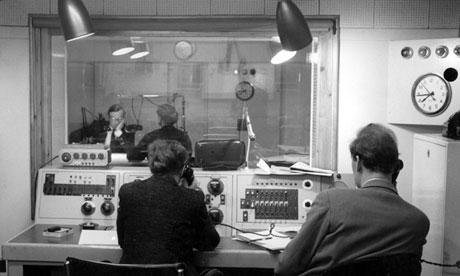
There are many images I had found on the internet showing what a recording studio would have looked like in the 1950's, this is searching for a BBC recording studio specifically. Here are some of the images that came up within my research, including the link as to where I found them: https://www.google.co.uk/search?hl=en&site=imghp&tbm=isch&source=hp&biw=1366&bih=622&q=BBC+recording+studio+in+the+1950%27s&oq=BBC+recording+studio+in+the+1950%27s&gs_l=img.3...1472.12707.0.12895.34.14.0.20.20.0.107.1073.13j1.14.0....0...1ac.1.64.img..0.21.1105.WQ1TQ-o92Fk

Image result for BBC recording studio 1950's


Image result for BBC recording studio 1950's

Using my imaginative skills, I'd like to see the first image being used to describe what the initial first broadcasting of 'The Sky at Night would've looked like in 1957. The second image could be used to describe what the older Patrick Moore would've used when he was being interviewed about the 'Sky at Night' broadcasts spanning across his whole career. And finally, the third image could be seen as what 'The Sky at Night' studio would've looked like once Patrick Moore had a bit more experience. As we can compare, there doesn't seem to be any crew members in the final image, whereas the first has a full crew.

Other than the recording studio used for the 'Sky at Night' broadcasts, the play would occasionally cut to other places within the time period of 1957. The second location featured in the play is Patrick Moore's house, where he lives with his mother, Gertrude. Just like for the recording studio, I thought it would help me if I was to research what Patrick Moore's house in the 1950's may have looked like as well. Here are some more images, as well as the link as to where I found them: https://www.google.co.uk/search?hl=en&site=imghp&tbm=isch&source=hp&biw=1366&bih=622&q=BBC+recording+studio+in+the+1950%27s&oq=BBC+recording+studio+in+the+1950%27s&gs_l=img.3...1472.12707.0.12895.34.14.0.20.20.0.107.1073.13j1.14.0....0...1ac.1.64.img..0.21.1105.WQ1TQ-o92Fk#hl=en&tbm=isch&q=houses+in+the+1950%27s&imgrc


The overall design of these two houses are quite similar in architecture, as they're both Suburban houses, but it's the second image in particular which I'd like to imagine the setting of Patrick Moore's house taking place.

The Language used in 'Far Side of the Moore'

Much like 'Atching Tan', the play is written in English. But to go a little bit more in depth about the words used in 'Far Side of the Moore', it is much different from that of 'Atching Tan'. The play introduces a whole range of scientific literature, much of it we all, as a group, had an issue understanding and/or even pronouncing when we had first read through the script. What's also much different about the language in this play when compared to the other, is that each character is, and has to be, quite precise with their wording. This goes specifically for the scenes featuring the radio broadcasts and any of the phone calls over the course of the play.

I feel that because of this, it makes 'Far Side of the Moore' a much more interesting play to perform when compared to 'Atching Tan'. When it comes to recording this play in the college recording studio, I think that this play would feature much more issues, as we all have to make sure we're speaking clearly, again, specifically, for the radio broadcasts in the play.

Now I'd like to delve into the language of my three characters, being Studio FM, Percy Wilkins, and George Adamski. These three characters put together, overall, don't have that many lines in the play, but, each has to be performed in a different way. This is mainly because, after doing some research, I had discovered that Percy Wilkins is Welsh, and George Adamski is Polish. Because of this, I've been encountered with quite a challenge, since the Welsh accent in particular is very difficult to pull off in my case. To help with this, I had found a video on YouTube, which would hopefully make my voice come across as having a Welsh accent, here is a link to the video: https://www.youtube.com/watch?v=cq-mEejECcU

To go along with Gareth Jameson in this video, he explains that the Welsh accent is going in an "up and down" sort of pattern. If I can be able to practice doing this with normal everyday language, then I'm sure it'll come in handy for when I come to performing my Welsh accent in the future.

As for the Polish accent, I already knew how to pull that off. In the past, I'd watched the movie called 'Iron Man 2', which features the villain known as Whiplash. In the comics, Whiplash's character is of polish decent, but he is living in the more harsh areas of Russia with his grandfather. There is a scene in the movie that always makes me laugh, but in this case for the Radio play, it also gave me some insight as to how I should perform a rough Polish accent. Here is the clip from the movie that I'm talking about: https://www.youtube.com/watch?v=yp0xNXb0rXE

Inspiration used for 'Far Side of the Moore'

When it came around to grabbing some inspiration for 'Far Side of the Moore', there wasn't really anything out there that we all, as a group, could think of. That was until our tutor showed us an episode of a series called 'The Hour'. The show was a 2011 BBC drama series centered on a new current-affairs show being launched by the BBC in June 1956, which is indeed very close to the date of 'Far Side of the Moore', being based in 1957.

Whilst watching the show, we could all get some insight into how the broadcasting process of shows would've worked in those days. In particular, I grabbed some insight from Ben Whishaw's character in the very first episode as he's counting down the numbers to the live broadcast. This would've helped my characterization for Studio FM, as he's not really featured too much within the play, alongside not having much variation in his lines.

Radio Blog Entry 1: Introduction, Thoughts and Opinions of 'Atching Tan' and 'Far Side of the Moore'

Introduction

For this new Audio ensemble assignment, we will be split into 2 different groups to be able to perform in 2 very different radio plays. The first Radio play being 'Atching Tan' by Dan Allum, and the second being 'Far Side of the Moore' by Sean Grundy.

We had took the time within our days at college to read through the scripts for both of these plays, following our tutors directive as to which characters she would like us to perform as.

Thoughts and Opinions on 'Atching Tan' by Dan Allum

The first radio play we had a read through of was 'Atching Tan' by Dan Allum. Unfortunately, I didn't have the opportunity to voice any of the characters in this play as I wasn't in the casting list for it, but I still sat and listened to the people who were. After listening to the play first hand, I'd like to present my thoughts and opinions on it:

Did I like the Story of 'Atching Tan'?

The radio play called 'Atching Tan' follows the story of a young girl called Lovvie whom has a particular interest and talent in singing. Throughout the course of the play, she meets with a drama teacher named John, whom thinks that she has some sort of extreme talent for dramatic performance, rendering him to teach her in the ways of acting. However, because Lovvie's main priorities are focused upon her family and her boyfriend, she stays away from the dramatic atmosphere of the stage to stay in her self uncontrollable lifestyle, following the decisions of everyone around her and not herself.

In summary, I'd like to say that I really enjoyed the story of this play, I felt a real emotional connection with the character of Lovvie and how she was going to handle each situation she had come across. I don't feel as though I lost interest or got lost anywhere in the story as it was all well connected by its scenes. Minus the occasional stuttering of the group performing it for the first time, I thought it was performed beautifully, and I can't wait to see the final result for when they perform this for real in a recording studio.

Did I like the Characters in 'Atching Tan'?

Although these two characters had a more prominent presence within the entire play when compared to the other characters, I did particularly like the characters of both Lovvie and John. The scenes containing these two characters alone was such a different atmosphere when compared to scenes that have Lovvie with her family, it was just a nice break and I felt as though it was a different play entirely. I really loved the relationship between these two characters, I felt like John was looking for his 'big break' in the world of acting, and Lovvie came to be his grand jewel. I loved the fact that in areas where Lovvie was giving up, John kept pushing her limits, but not so much to the point that he's almost commanding her, which is what I felt her family was doing.

Was there anything I didn't like about 'Atching Tan'?

I can't think of anything I didn't particularly like about 'Atching Tan', other then how Lovvie is treated by everyone around her, excluding John. If anything, I wish Lovvie and John could have had a more developed relationship with one another, not that it isn't good already, but I feel that there is much more that the writer could've done with these two characters. I'd also like to know what happened between the two in the years following the plays event's. Did she get a career in acting? Did she pursue more in the ways of singing to eventually become a professional singer. Could Lovvie and John possibly have had a romantic relationship despite the age gap between them? So many questions that need to be answered but may not come around.

To conclude, I'd like to present my overall rating for 'Atching Tan' by Dan Allum as a strong 8.5/10, and would recommend for everyone to listen to this play if they get the chance.

Thoughts and Opinions on 'Far Side of the Moore' by Sean Grundy

The second radio play we had a read through of was 'Far Side of the Moore' by Sean Grundy. For this read through, I was presented with, and had the opportunity to choose, the characters named Studio FM, Percy Wilkins, and George Adamski. After reading through this play, I'd like to present my thoughts and opinions on it, following the format I've already done with 'Atching Tan' above.

Did I like the Story of 'Far Side of the Moore'?

The radio play called 'Far Side of the Moore' follows the true story of a man called Sir Patrick Alfred Caldwell-Moore, and the origins and uprising of him becoming the presenter of the longest running television series with one single presenter. The series is called 'The Sky at Night', although it was originally drafted as 'Star Map'. The show was first aired on 24th of April, 1957. As we follow Patrick on his journey, we learn of his personality, his "arch enemies" and colleagues, and, more importantly, his past and future experiences.

In summary, I really liked this play as it is much different from any other play that I've read before in the past, could be mainly because of its scientific purpose. I really like how the story kept cutting from past and future, and how the elderly Patrick Moore delivers his lines in a sort of narrative way throughout the play whilst his younger self repeats the words he once said. I compliment Luke Patrick Engelen's performance in this role, I thought he was the perfect representation for the character, especially with his voice, as there's a line in the play, delivered by Leonard Miall, which states that Patrick Moore speaks fast to get twice the information across, which suits Luke's vocal ability.

Did I like the Characters in 'Far Side of the Moore'? 

Overall, I like each and every character in the play. I feel that all of them have much more purpose being there when opposed to some of the characters in 'Atching Tan'. I love the rivalry between Patrick Moore and Dr. Henry King, his "arch enemy", it brings an entirely different mood to the play when they're both in the same scene, I was even left wondering who I should fight against the other with in that situation. I loved the fact that some of the characters had very subtle comedic moments throughout the script, complimenting the writers ability in character development, and also maybe historical knowledge of the events in the play.

Was there anything I didn't like about 'Far Side of the Moore'?

If anything, I obviously didn't like the fact that the characters I was presented with didn't have too many lines to say. But when thinking about it properly, that may be a good thing for me because of my weakness in portraying a welsh accent. I also didn't like the fact that Patrick Moore's mother had quite a small role in the play as well. I for one liked her character and would've preferred to have heard her more, but in the purpose of the plot, I'm not sure where she could fit in.


To conclude, I'd like to present my overall rating of 'Far Side of the Moore' by Sean Grundy as 9/10, and would also recommend this play to anyone whom may b interested in Radio plays.

Tuesday, 1 December 2015

Voice and the Actor Assignment 1 - Entry 3: Analysing the Voice of a Family Member and a Famous Person

Voice of the Family Member

For this task, I'll be using my step mum, Jenny, as my subject.

What kind of tone is the voice: She has quite an extensive range of tone in her voice.
How fast or slow do they speak: Slow, clear, and concise. Get's faster the angrier, or agitated she gets.
Do they pause a lot: No, she's often told "Take a breath"
Do they find it hard to project: Professionally, No. Personally, Yes. She's a lot more shy and quieter.
Do they articulate their words: Yes
What is their pitch like: She's definitely not monotonous, she has a varied pitch depending on person/animal circumstance.
Do they emphasise certain words: No
Do they speak in one tone: No
Do they have specific difficulties when pronouncing certain words: No, she has a large vocabulary in several languages.
Do I like their voice: Yes, it's powerful, it's empathic, and very articulate.
Do I dislike their voice: No, I find myself more likely to talk to her, she's always passionate with what she talks about, and her tone of voice matches the mood of the conversation.
Is her voice loud/voluminous: Yes, more times than often, she's been told "Stop shouting" even when she's not.
Is the voice quiet: At times.
Is the voice deep: No.
Is it high/low: It's kind of in-between, but with more feminine traits opposed to masculine.
Is it strong: Yes.
Is it weak: No.
Is it shaky: No.
Is it husky: No.
Is it crisp: Yes.
Is it clipped: No.
Is it drowning: It can be, she can be overpowering.
Is it nasal: No.
Is it squeaky: No.
Is it crackly: No.
Is it raspy: No.
Is it distorted: Only by accents.

Voice of the Famous Person

For this task, I'll be using Nicole Kidman as my subject.

What kind of tone is her voice: Same as my step mum, She has quite an extensive range of tone in her voice.
How fast or slow do they speak: Same again, Slow, clear, and concise.
Do they pause a lot: Yes.
Do they find it hard to project: Sometimes.
Do they articulate their words: Yes.
What is their pitch like: She's quite clear.
Do they emphasise certain words: Yes.
Do they speak in one tone: No
Do they have specific difficulties when pronouncing certain words: No.
Do I like their voice: Yes, I find it calm, passionate, and articulate.
Do I dislike their voice: No, it has a soft and gentle tone which I find very relaxing and assuring. Even if she read the phone book, it would sound the same.
Is her voice loud/voluminous: Sometimes.
Is the voice quiet: At times.
Is the voice deep: No.
Is it high/low: Like my step-mum, it's kind of in-between, but with more feminine traits opposed to masculine.
Is it strong: Yes.
Is it weak: No.
Is it shaky: No.
Is it husky: No.
Is it crisp: Yes.
Is it clipped: No.
Is it drowning: Yes.
Is it nasal: No.
Is it squeaky: No.
Is it crackly: No.
Is it raspy: No.
Is it distorted: No.

Voice and the Actor Assignment 1 - Entry 2: Personal Voice Assessment

How do I rate my Voice?

The rating system for this task started with 1 being the lowest or labelled 'Strongly Disagree', and 5 being the highest or labelled 'Strongly Agree'.

Question one asked if I have a good, clear voice production.  To this, I answered and rated myself with a 5 out of 5, so I strongly agreed with myself that I have the ability to produce a good, clear voice.

Question two asked if I think I have good articulation.  To this, I answered and rated myself with a 4 out of 5, so I agreed with myself that I can correctly pronounce words.

Question three asked if I think I have a good pace with my voice.  To this, I answered and rated myself with a 4 out of 5, so I agree that I can produce a voice with a fast or slow tempo with control and fluency.

Question four asked if I think I have a good variety of tone and pitch with my voice.  To this, I answered and rated myself with a 5 out of 5, so I strongly agree that I can produce and create a strong, powerful, loud voice with control and I can also create a good tone of voice alongside.

Question five asked if I think I have a good breath control.  To this, I answered and rated myself with a 5 out of 5, so I strongly agree that I can have a large amount of breath control when speaking so that there are no pauses in my dialogue unintentionally.

Why did I rate myself with these results?

For all of these questions that I have answered, I gave myself very honest high ratings.  I did this because I do have a very strong, clear and understandable voice. I think that my hard work in terms of fitness also helps, but more so within the breath control. By going to gym and building on my muscles, specifically on my back, it makes my overall posture much better than others. This allows me to breathe properly whilst performing, have very good projection, and also to physically stand tall and have a stronger stage presence when among others.

Voice and the Actor Assignment 1 - Entry 1: Analysis of the Voice

What are the characteristics of my voice?

I think that I'm very well spoken, I portray a typical British accent. I'm very precise in my wording, I have the ability to enhance my voice with emotion. I have a good command of the English language. My tone is good and my diction is clear. I am quite articulate. I have good posture - which contributes towards my breathing, which originates mainly from my fitness level. My vocal 'colour' is focussed. My weakness is articulating the tones of sadness, and upset etc.

I have a habit of, when being chastised, muttering under my own breath comebacks towards what the other person is saying. I speak at a medium pace, but, when placed in a scenario where I'm upset or angry, my pace is accelerated. I think I vary my rhythm, I speak at the same pace as my peers, depending on the situation, circumstance, and topic of conversation. My pitch is strong and precise because of how well I hold myself - due to the fact of my fitness levels, which ensures correct posture. My fitness levels also enables me to breathe correctly, which in turn, ensures me to complete my sentences without sounding rushed and/or short of breath. Where required, I can display dramatic pauses - an example for me, was when I performed the monologue by Skin-Lad in our performance of Jim Cartwright's play named 'Road'.

Unless I'm 100% dedicated to I'm saying, my confidence can falter, leaving my voice quieter and unsure in tone. In articulation, I have a weakness sounding the letter 'r'. I am able to project my own voice depending on the environment of the performance taking place. At times, I can sound monotonous. Because of my current home environment, I have been exposed to a larger vocabulary, more adult interactions, which, in turn, has increased my confidence in front of any audience. Although both of my biological parents are from the north of the UK, I don't in fact possess any of the vocal mannerisms that they would use. I do have a weakness with some accents, a strong example would be the Northern accent in-particular.

In what ways do these vocal qualities benefit and/or hinder me as a stage performer?

I guess all of these vocal qualities benefit my own performance(s) in a way, since it portrays my own vocal stage persona. However, it also hinders me since, because of my weakness with accents and sometimes sounding monotonous, I feel that it reduces my overall presence on stage when compared to other actors who can do accents and not sound monotonous.

What vocal exercises might be suitable for building on my strengths and weaknesses?

Exercise 1: Producing A Humming Sound

By performing a humming sound through the use of, primarily, my throat, it would allow my vocal folds to warm up, resulting in any preparation for my vocalisation performance to enhance.

Evaluation For Exercise

Performing this exercise does definitely make your throat feel a lot clearer, this along with having a drink of water is a great combination. Projecting words also left my voice less strained than if I had said them without having done the exercise.

Exercise 2: Stretching The Muscles

This isn't necessarily a vocal exercise, but it contributes to the delivery of the voice and gives you more focus.

Doing some simple bodily stretches increased the overall movement within my body, since it released any unwanted tensions within it.  It had also given me much more energy and had also increased my overall focus towards both my physical posture and the vocal folds, for better articulation both physically and vocally.

Evaluation For Exercise

Since I go to the gym and exercise quite often throughout the week, I do feel a bit of tension and stress within my muscles around my body. After having done quite a few stretches all around, I felt much more active for any later activities I'd performed, since my body had felt free of movement with no obstacles, such as the stress and tension.

Exercise 3: The Spinal Role

Through doing this, I can maintain a more steady physical body posture and also keep a strong breathing pattern. To start off the exercise, you have to bend your upper body down towards the ground, with knees bent. After doing this, you can choose to flop around your arms, and then after you slowly rise up to correct posture with your head being the final thing to be correctly aligned/balanced.

Evaluation For Exercise:
It had made me become much more energetic in what we were going to be achieveing in this process. My body had felt a lot more relaxed post spinal role compared to before. My body also felt a lot more warmer than before, maybe to do with the spinal role and letting all of the blood go through all of the areas in my body.

What other Vocal exercises will improve your technique? Why?

Exercising your voice every day

It's a common misconception that taking voice lessons will automatically improve your vocal ability. One time, you may hear Simon Cowell on Britain's Got Talent/American Idol, or even your teacher at school, recommend vocal lessons. There is definitely validity in this, however, you have to put forth the effort to make this worthwhile, even singing along to your favourite song won't do it.

I ask myself one question during this analysis: "How can I improve my voice?"

The answer to this question is: Exercise, regularly!

If someone wants to become a stronger vocalist in performance, by having increased vocal range and able to control it with ease, they have to exercise their voice daily. The Vocal Cords are a muscle in the Human Body. Like every other muscle in the Human Body, you will not gain any strength and/or stamina by not working them out regularly.

The Vocal Cords are a unique instrument to use, especially as an actor in a performance. If someone doesn't exercise their Vocal Cords regularly, they will have trouble projecting their voice more than if they had done exercises for it, which inevitably improves that actors performance in vocal terms.

You should work out your voice at least 20 minutes daily (at minimum). As time goes by, and the voice seems to be improving, extend the exercise to 40 minutes or an hour daily.

Alexander Technique

To achieve good posture, a person must remain focused and draw all of their attention to their mind where the building point of good posture begins.  With this being said, there is a good posture building technique used frequently for actors in the Performing Arts Industry called the Alexander Technique.

The Alexander Technique is a way of learning how to move mindfully through life. The Alexander process shines a light on inefficient habits of movement and patterns of accumulated tension, which interferes with the body's innate ability to move easily and according to how it was designed.  It's a simple, yet powerful approach that offers the opportunity to take charge of one's own learning and healing process, because it's not a series of passive treatments, but an active exploration that changes the way one thinks and responds in activity.  It produces a skill set that can be applied in every situation.  Lessons using this technique leaves one feeling lighter, freer and more grounded.

Excess tension in the body can cause a variety of unpleasant symptoms and it can interfere with the body's ability to perform activities well.  Therefore it is not surprising that actors use the Alexander Technique because they are in physical pain (backaches, sore neck/shoulders etc.) and/or because they are performers, much like myself, who want to increase the quality of their singing, playing, acting or dancing.

This technique is along the lines similar to doing meditation exercises, they both relieved my body of unwanted stress and tension, but doing the 'Alexander Technique' had made my body and voice feel much lighter in terms of weight.

This was more obvious to me compared to my voice overall, since I have quite a deep voice, and whenever I spoke, to me, it just felt a lot more lighter and easier to talk than it did prior to performing the 'Alexander Technique'. I think the reason that my overall voice production is a lot easier to develop is because my body is in a full relaxed state, much like when I'm sleeping.  To further evidence this point, in the past, there have been occasions where I've heard one of my family members talking in their sleep, and when listening to their voice, it had sounded much more lighter and well developed than normal, when they are fully awake.  This may have been the same possible effect that I've experienced after having done the Alexander Technique and it makes me realise that if I do this more often in the future, my voice overall will improve.

Perhaps the main challenge facing actors and performers, in general, is stage fright. As the fear increases, the breathing of the individual becomes shallow, and the body also becomes tense and fixed. The Alexander Technique is a form of stress management that generates an inner calm, and a capacity for coping with performance anxiety without freezing. The technique also heightens the ability to incorporate character roles, and enhances stage presence.

The Alexander Technique originated as a practical method to sort out Alexanders personal voice problems. Today, the same technique is still used to eradicate breathing difficulties, avoid vocal strain, generate resonance and improve tonal quality. Vocalists often overexert themselves in an effort to achieve results. Through the Alexander Technique, they learn that less effort brings better results.

Humming a Still Tone

For this exercise, I was required to hum a random still tone which was both best suited for my vocal cords and for me to be able to execute for the longest time.

For the purpose of this exercise, I had chosen to do a deep sounding still tone, since this is the register of voice that I have, resulting in me to be able to go the longest due to being used to that pitch of voice.  I had performed this exercise twice with the second time doing a different still tone that wasn't suited to my vocal production.  For this, I had chosen to do a high pitched still tone, which had cracked at some points, resulting in the air that I'd inhaled to be wasted since I didn't expect it to happen.  Doing this did give me a weird feeling in my throat also after I had performed it, which could mean that my vocal cords either didn't like me doing it or it was trying to get used to that pitch, and due to it vibrating much more, it started to give a weird sensation.

“Why fly so high?”

With this exercise, you to project your voice by performing with different tones and pitches of voice using both your Nasal and Oral Cavity.

The lines you have to say are:

"Why fly so high? Said Naughty Nora, whilst eating an apple, with Zoe the Zebra in the Zoo"
(High/Light Voice)       (Blocked Nasal)        (Open, Deep voice)       (Beating the upper chest)


For the "Why fly so high" part of the exercise, when trying to project a high/light voice, it did
feel like my voice was 'braking' since I naturally have a very deep voice, but after having done
the exercise again, I did manage to successfully pull of a high/light voice for the purpose of this
part of the so called song. 

Friday, 27 November 2015

'Much Ado About Nothing' By William Shakespeare - Character Profile & Study

Character Profile for Leonarto

Name: Leonarto

Age: 42

Gender: Male

Race: Caucasian/White

Place of Origin: Seeing as Leonarto is the Count of Messina, I'd like to interpret that he is actually from Messina. I don't believe there's any mention in the script whatsoever of where Leonarto is actually from, so this is my best judgment.

Physical Appearance (Costume Decision): I'd like to follow this appearance for my interpretation of Leonarto:
  • Beige straw hat
  • Gold neck chain
  • Hawaiian shirt
  • Beige shorts
  • Green Wellies
  • and also the occasional sunglasses for the purpose of the second movement sequence.
This was the final outcome of my costume, featuring me in the silent disco movement sequence as the DJ:


Occupation: Count of Messina and Part-time DJ

Taking over from the original script of 'Much Ado About Nothing', Leonarto is still the Count of Messina in our interpretation, but he has postponed his position in order to properly organise the festival which shall celebrate the return of Don Pedro, Benedick, and other background characters (these are not featured in our performance).

While he isn't the Count of Messina for a short period of time, this means that Leonarto can use/test his most used hobby at the festival, this being a Disk Jockey. He hasn't been a DJ for too long, Leonarto only picked it up when he went to a party, before the plays events, and saw the local DJ playing. This inspired him to learn how to play a musical instrument, which inevitably came to be the DJ stand.

Though not being too hard a process to grasp, he has only been practicing for a few weeks before the festival took place, meaning that no-one has seen him play. His first time in front of anyone was in the Silent Disco movement sequence of our production. Whilst performing, he was complemented by the Messenger, whom had come over and shook his hand saying the words "Nice song, man!"

Monetary Status: Very Wealthy, perhaps too wealthy!

In the original take of 'Much Ado About Nothing', Leonarto owns a whole estate which the play takes place in, he has also held parties in his house in many other interpretations that we've watched in class. This of course means he's fairly rich, which makes sense along his occupation as the Count of Messina. Leonarto has so much money that the word 'Money' isn't part of his dictionary. He doesn't even need to worry about how much he spends. This is why he spends all of his so called earnings on parties, arranging festivals, weddings etc. Leonarto only wants the best, and he will spend any amount of funds towards getting it.

Does Leonarto have any sort of relationships?

Seeing as Leonarto is of quite a high status, maybe not as high or around the same level as some characters e.g. Don Pedro, he generally, I feel, is just friends with everyone around him. This is, of course, excluding Borachio and Don John for the reason of Act 2 Scene 2 by form of the whole scene. The whole conversation between the two characters in this scene suggests that they want to ruin the wedding between Claudio and Hero, which would inevitably physically "kill" Leonarto to see this happen to his own daughter.

Although, for our interpretation of 'Much Ado About Nothing', I'd like to picture that Leonarto's best friends are Don Pedro, Claudio, and perhaps Benedick from the simple reason of how we acted out in Act 2 Scene 3. There's obviously a lot of banter and playing around going on in this scene towards Benedick, whom is listening in on their 'acted' conversation.

Leonarto is already good friends with Don Pedro, seeing as he hosted a party in the original play to celebrate his return, and also his soldiers, from the war that took place. I'd think that Leonarto is starting to picture Claudio as his own son. Obviously, due to the plays plot, we know that he is marrying Leonarto's daughter, Hero, so it would be practical for Leonarto to get to know Claudio better and treat him as his own. Benedick is Don Pedro's leading commander from the war, so he is of higher status than the other soldiers in the play, also suggesting that he could have relations with higher status characters such as Leonarto. I'd like to think, from our interpretation of the play, that the two characters don't talk very much, but when they do converse, it's mostly banter.

Does the character have any particular interests?

Seeing as he's comfortable enough playing on the disk jockey set between Act 2 Scene 1 and Act 2 Scene 2, I'd like to think that Leonarto's key interest, and perhaps outside of scene hobby, is being a part time DJ to go along with his duties as the Count of Messina.

Another key interest of Leonarto's is that he likes/tries to look 'cool' in social interaction. As we can presume from my costume choice, Leonarto is quite colourful and he's very 'out there' when compared to the other characters on stage.

I believe that the final thing that Leonarto loves partaking in is acting. From our interpretation of Act 2 Scene 3, when Balthasar leaves the scene, the whole conversation between Claudio, Don Pedro, and Leonarto is all part of a big act to get Benedick in love with Beatrice. However, Leonarto takes this too far because of his 'inexperience' in acting.

Does the character have any particular dislikes?

I'd like to think, from my interpretation of Leonarto, that he has no dislikes towards anything. Leonarto, to me, is a very open-minded person, and takes on anything which he thinks will amuse him, or others, for a while.

If there is any sort of dislike that I can think of, it's that I'd know Leonarto would absolutely hate to see anything happen to his daughter. Leonarto wants the best for Hero, as he should being her father, and he'll go through hell and back to get whatever she wants in life.

Character Study for Leonarto

What were the Inspirations for my portrayal of Leonarto? (also mentions physicality and vocalisation notes)

The Dad from 'Friday Night Dinner':

This is a kind of difficult topic to talk about since, at first grasp of playing Leonarto, I didn't really have any inspiration, I sort of just did my own thing with the character. I remember from earlier rehearsal sessions that the way I said my lines came across as very aggressive, which isn't right in the slightest. I was told to be more like a 'Mac Dad', which is basically where you think you're funny when you're really not. This was when I got told by Matthew Todd to grab some inspiration from the dad character in 'Friday Night Dinner'. Here is a clip of him to show how he is: https://www.youtube.com/watch?v=BekwAtZjExc

When looking back at this video a second time, I could only look towards the personality of the character. Whilst he is indeed funny, he was also quite aggressive and very much an attention seeker in my opinion. The only sense of inspiration which I actually grabbed from this character was the randomness of him. Having done the performance, there were quite a few random moments for my portrayal of Leonarto on stage, particularly in the movement sequences. This combined with my ridiculous, very 'out there' costume choice, made it even more funny and relatable to the audience members.

There's one particular bit in the second movement sequence which I absolutely loved doing, which is right when I come on stage. I enter the stage miming along with the song choice we had for the sequence, the mime act included me playing a drum set and alongside playing a guitar, I repeated this act about 4 times before lifting Frankie in the air. Whilst doing this act was very attention grabbing, I had a very good reaction from the second live performance when the parents came to watch us, I remember that as soon as I came on stage, the audience were immediately laughing, and I could only think it was because of me.

This left me feeling quite pleased with my performance, since leaving the stage with more satisfaction than I had hoped to achieve and getting a very good review of my performance from multiple parents when I had left the theatre afterwards.

Frank Gallagher from 'Shameless' (the British version):

Another inspiration, which Sally told me to take interest in, was the character of Frank Gallagher in the British TV programme 'Shameless'. She had mentioned this inspiration of character to me quite early on in the rehearsal process and this was the video that we had watched:
https://www.youtube.com/watch?v=Jx3Zdl_V3zo

This inspiration does make sense, looking back at it, since I remember not really having much physical traits to the character of Leonarto at first, and obviously from this clip, we can analyse that Frank Gallagher is a very physicalized character, whilst he's talking. He uses his hands a lot when he breaks the fourth wall and is talking to the audience about what's going to happen or is happening in the episode.

Analysing it more and more, this reminded me of the character called Scullery in 'Road'. We had performed 'Road' in the previous year for our last production, and I think that Scullery is a great example to compare against Frank Gallagher, as he also speaks to the audience, breaking the fourth wall, to inform the audience as to what's occurring in the town.

I didn't really take as much inspiration from this character compared to the dad from 'Friday Night Dinner', but what I did take grasp of was the hand play. I'd like to believe I was using my hands quite a lot in my performance whilst I was speaking, which did help when I was adding the emphasis and inflection to certain words. I felt that this made my performance of Leonarto come across as being more believable in a way, I'm not just doing a casual act, but I'm becoming the character himself, placing myself in the situation he's in and doing what I think he would do in those circumstances.

When we had received feedback from Sally before another one of our performances, she commented that I came across as understanding what I was saying more than anyone on stage. This may be one of the reasons why perhaps? I can't really say what she saw that made it seem like I knew what I was doing, but I would like to think that this is the reason. Hopefully, when I get my grade back for this assignment, she could give me more context on what she meant when she said this, so I can try and carry it over to the next performance(s).

Analysing Leonarto's Personality

For my interpretation of Leonarto, it helped me more when I looked at the full script of 'Much Ado About Nothing' to find out what other characters were saying that is relevant towards me to receive a full understanding of how I should perform the role in respect to the original author's desires. Here, I'll mention a majority of the personality traits of Leonarto, showing analysis from the script, whilst also using the diagram which I had mentioned in Week 3 of my 'Much Ado About Nothing' By William Shakespeare Full Weekly Blog Study:
  1. Leonarto is Honourable
I had received this information about my character from the text, which is delivered by another character announcing relevant information. The character in question is Don Pedro in Act 1 Scene 1.

He had this quote to say:

"You have it full, Benedick. We may guess by this what you are, being a man. Truly, the lady fathers herself.—Be happy, lady, for you are like an honourable father."

I had used the website called 'nofearshakespeare' to translate this text into a modern audience interpretation.

This is what the same quote came out to be said:

"Ah, he got you back, Benedick! Leonarto clearly knows your reputation with women. Seriously, though, the lady resembles Leonarto so much that there can be no doubt about who her father is. Congratulations, lady: you resemble a most honourable man."

      2. Leonarto is Polite (but serious at the same time)

I had received this information about my character from the text, which is delivered by another character announcing relevant information. The character in question is, again, Don Pedro in Act 1 Scene 1.

He had this quote to say:

"That is the sum of all, Leonarto.—Signior Claudio and Signior Benedick, my dear friend Leonato hath invited you all. I tell him we shall stay here at the least a month, and he heartily prays some occasion may detain us longer. I dare swear he is no hypocrite but prays from his heart."

Using 'nofearshakespeare', the same quote translates to this:

"And that’s everything, Leonarto.—Claudio, Benedick—my dear friend Leonarto has invited you all to stay here at Messina. I told him we’ll stay for at least a month, and he says that he hopes we’ll stay longer. I think he’s actually serious, and not just being polite."

     3. Leonarto is Respected

I had received this information about my character from the text, which is delivered by another character announcing relevant information. The character in question is, once again, Don Pedro in Act 1 Scene 1 (this is the last time!) but also Benedick in Act 2 Scene 3.

Don Pedro had this quote to say:

"Well, you temporize with the hours. In the meantime, good Signior Benedick, repair to Leonarto’s. Commend me to him and tell him I will not fail him at supper, for indeed he hath made great preparation."

Using 'nofearshakespeare', the same quote translates to this:

"Oh, you’ll soften as time passes. While you’re waiting for that to happen, though, hurry to Leonarto’s. Give him my respects, and tell him I’ll definitely be there for dinner, since I know he has gone to great lengths for this meal."

Benedick had this quote to say:

"(aside) I should think this a gull but that the white-bearded fellow speaks it. Knavery cannot, sure, hide himself in such reverence."

Using 'nofearshakespeare', the same quote translates to this:

"(to himself) I would take this as a joke if the old man weren’t saying it. Mischief surely can’t be hiding in such a respectable man."

How does this all affect my implications for performance as Leonarto?

I guess this had affected my performance in some way since I had always pictured Leonarto as being quite an honourable, and also respectable man. These quotes all had affects on my physicality of the character, I stand tall among others and portray a sense of proudness within myself. I have a strong stage presence because of this. It heavily expresses my movement, which is both calm and muscular at the same time, I get to the point of what I'm doing instantaneously, using as much physical moment as possible. It also makes a compliment to my vocal ability as the character, I speak in a strong, collective, and well thought manner, showing as much expression, emphasis and inflection as possible to give more meaning and purpose to the lines I have to say.